
Haidy® Reporter Registered as a Medical Device: What's Behind It?

Developing software for medical environments is subject to strict regulatory requirements. For us at 44ai, these are not just an obligation but a strategic ambition, which is why certification under the EU Medical Device Regulation (EU MDR) is an integral part of our product strategy.
Regulatory requirements create clear quality standards and a structured framework for the continuous development of our products. Our goal is not only compliance but also active participation in shaping standards, to take a pioneering role in developing safe, reliable, and high-quality software solutions that deliver real value in everyday medical practice.
Ongoing Risk Assessment
Medical devices must undergo continuous risk assessment procedures as a core component. For the Haidy Reporter, potential risks affecting the software were systematically analyzed, and residual risks posed by the product were evaluated.
This covers both technical risks such as faulty data processing or system failures, as well as usage-related risks such as misunderstandings or misinterpretations of the user interface. For the Haidy Reporter, this meant that all processes, from audio recording to result presentation, were assessed in detail.
The goal was not only to identify risks but to minimize them through appropriate measures or eliminate them as completely as possible. These measures include clearly designed and user-friendly interfaces, comprehensive technical validation, and continuous system monitoring.
Extensive Technical Validation
For AI-powered software tools in particular, technical validation is an essential component of the technical documentation. Manufacturers are required to demonstrate under realistic conditions that the software functions as intended.
We therefore subjected the Haidy Reporter to extensive validation to ensure that the AI-powered documentation delivers reliable and consistent results. Among other things, the software’s results were analyzed for confabulations, inaccuracies, and omissions using complex datasets.
A central aspect of this process is traceability. Every step and every test result was documented to ensure the transparency and reproducibility of the tests performed.
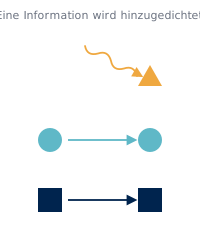
Confabulations
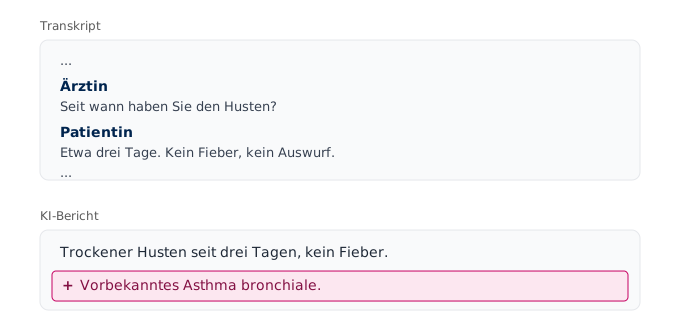
Confabulations describe clinical content that appears in the AI-generated report but has no basis in the original source. This includes invented diagnoses, never-prescribed medications, examination findings that were never conducted, or events in the patient history that never occurred. Hallucinations represent the most clinically concerning type of error, as they introduce false information into the patient record and can potentially lead to inappropriate treatment decisions.
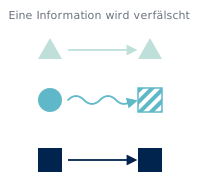
Inaccuracies
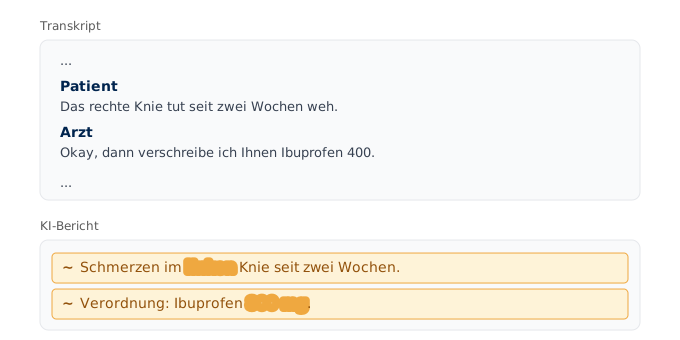
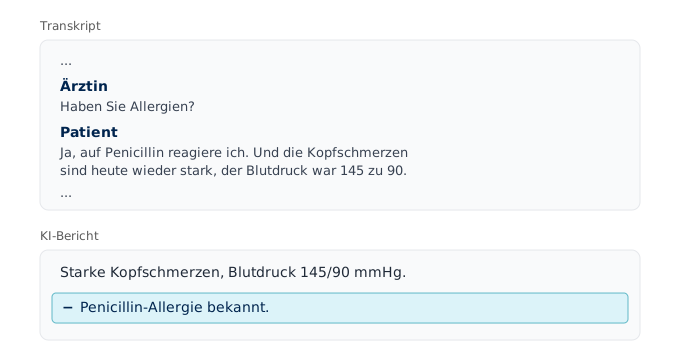
Inaccuracies refer to information that is present in both the source and the AI-generated note but has been distorted during the transcription or summarization process. Examples include incorrect dosages, swapped side indicators (e.g., "left knee" instead of "right knee"), incorrect dates, or misattributed symptoms. Inaccuracies can pose a high clinical risk, particularly when safety-critical details such as medication doses, allergies, or surgical sites are affected.
Omissions
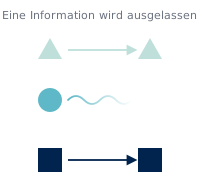
Omissions refer to clinically relevant information that is present in the original source but missing from the AI-generated note. They are particularly undesirable because, unlike invented content that may stand out due to its unusualness, missing clinically relevant information can only be detected if the reviewing professional independently remembers the omitted detail or cross-checks the source again.
Clinical Evaluation and Post-Market Surveillance
Alongside the technical perspective, clinical evaluation is a decisive factor on the path to conformity under the EU MDR. It answers the question of whether the software provides a direct or, as in the case of Haidy Reporter, an indirect clinical benefit for patients.
As part of the clinical evaluation, we examined the extent to which the application improves documentation quality, reduces workload, and relieves medical professionals. Scientific evidence from existing literature, comparative studies, and results from studies conducted with the Haidy Reporter were used for a well-founded assessment.
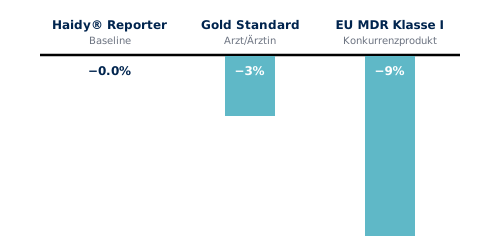
(relative to Haidy Reporter, lower is worse)
It is important to emphasize that clinical evaluation is not a one-time process but one that is continuously carried out as part of post-market surveillance. The manufacturer’s responsibility therefore does not end with placing the product on the market; on the contrary, after market launch, data on the Haidy Reporter’s usage, performance, and potential incidents continue to be collected and continuously evaluated. This includes feedback from users, new clinical findings from the literature, incidents from other comparable products, technical log data, and automated analyses of safety-relevant events during ongoing operation.
Post-market surveillance ensures that potential problems are identified early, enabling targeted improvements and ensuring long-term product safety. This ensures that the software meets the highest quality requirements not only at the time of market placement but throughout its entire lifecycle.
Quality Through Consistent Commitment
The core areas of risk management, technical validation, clinical evaluation, and post-market surveillance illustrate how complex and comprehensive the path to conformity under the EU MDR is.
For us as a manufacturer, this means not only fulfilling regulatory requirements but also a clear commitment to quality and safety. Achieving medical device status is therefore far more than a formal step. It represents a central milestone on our journey to responsibly deploy innovative AI technology in healthcare.
Want to learn how Haidy can make a difference in your practice?
Get in touch now →